
Wuhan University (WHU), a key comprehensive university directly under the Ministry of Education, is among the prestigious "985 Project" and "211 Project" institutions, as well as a pioneer in the "Double First-Class" initiative.
The university's origins trace back to 1893 with the establishment of Ziqiang Institute by Zhang Zhidong, the then governor of Hubei and Hunan provinces during the late Qing Dynasty (1644-1911). Over time, the institution evolved, adopting its modern identity as Wuhan National University in 1928, making it one of China's earliest comprehensive universities. By 1946, WHU had established a balanced academic framework encompassing the arts, law, sciences, engineering, agriculture, and medicine. A significant milestone came in 2000 when it merged with Wuhan University of Hydraulic and Electric Engineering, Wuhan Technical University of Surveying and Mapping, and Hubei Medical University, marking the beginning of a new era in its distinguished history.
WHU's academic excellence has been widely recognized. In 1999, the world-renowned journal Science hailed it as one of China's most outstanding universities. By 2024, WHU ranked 134th in the Times Higher Education (THE) World University Rankings, 89th in the Academic Ranking of World Universities (ARWU), and 194th in the QS World University Rankings.
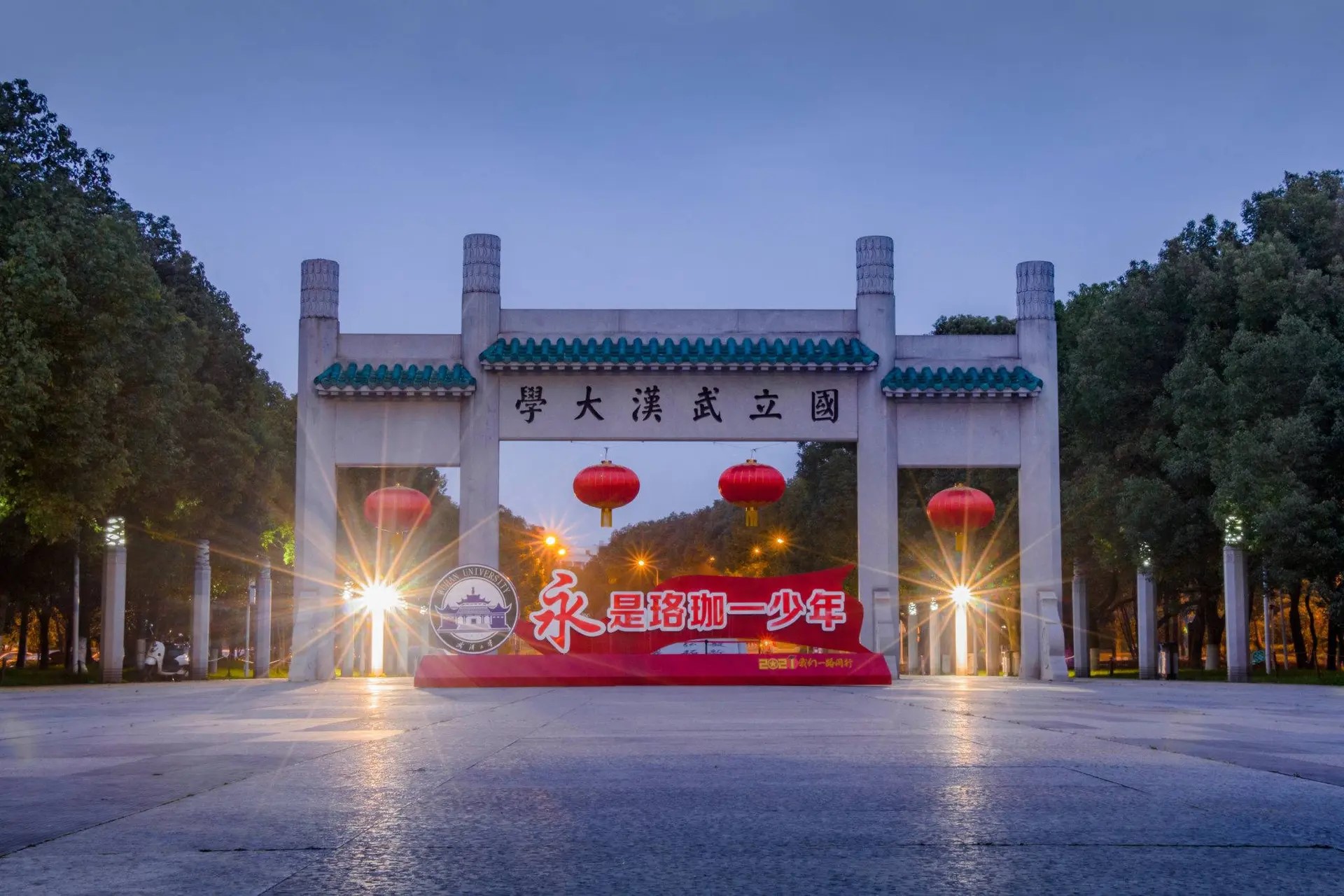
Nestled beside the scenic East Lake and embraced by Luojia Mountain, WHU is celebrated as "China's most beautiful university". Its palatial, Sino-Western architectural complex exudes a classic elegance and grandeur, with 26 early structures designated as "key cultural relics under national protection".
Academically, WHU offers a comprehensive array of programs across 13 major disciplines, including philosophy, economics, law, education, literature, history, science, engineering, agriculture, medicine, management, arts, and interdisciplinary studies.
The university actively embraces its societal responsibilities, aligning with national strategies and contributing to local socio-economic development. Through collaborative partnerships with national ministries and commissions, enterprises, media, other universities, and local governments, WHU has made significant strides in poverty alleviation, rural revitalization, and public health.
Guided by its motto, "Self-improvement, Perseverance, Truth-seeking, and Innovation", WHU pioneers the "Creativity, Innovation, Entrepreneurship" educational model. It is dedicated to nurturing versatile talents with solid foundations, broad expertise, high quality, and innovative capabilities. With over 700,000 alumni, including more than 100 academicians, WHU has significantly contributed to national development and global progress.
With its remarkable achievements in education and research, WHU has gained widespread international recognition. The university has established partnerships with 341 universities and research institutions across 53 countries and regions, enhancing its global presence and collaboration.
With over a century of history marked by resilience and excellence, WHU remains steadfast in its mission to foster virtue, advance society, and improve human welfare. Embarking on a new chapter, it strives to become a world-class university with distinct Chinese characteristics.